Surface analysis
Surface describes a surface; Face is a bounded region on it. For example, the side face of a cylinder has a limited height, while its cylindrical surface extends in both directions.
Getting a surface
face.surface() returns the underlying surface of a face. Use cylinder_surface(radius) to create a cylindrical surface around the Z axis.
from zencad import *

plane = rectangle(20, 10).surface()
point = plane.point(5, 3)
normal = plane.normal(5, 3)
assert abs(float(point.z)) < 1e-7
assert normal.value() == (0, 0, 1)
Parameters and normals
A point on a surface is specified by two parameters, u and v. Their meaning depends on the surface: for a cylinder, u is an angle in radians and v is height along Z.
| Method | Result |
|---|---|
surface.point(u, v) |
A Point3 point |
surface.normal(u, v) |
A unit normal Vector3 |
surface.u_range(), surface.v_range() |
Parameter ranges with .lower and .upper fields |
surface.u_iso(u) |
A curve at constant u |
surface.v_iso(v) |
A curve at constant v |
The ranges belong to the surface, not the face boundaries; they may be infinite. A Face also provides face.normal(u, v) directly. Omitting the arguments uses u=0, v=0.
Curves on a surface
surface.map(curve2) maps a two-dimensional curve from parameter space (u, v) onto the surface and returns an Edge. On a cylinder, a sloping line segment in (u, v) becomes a helix.
The example shows the helix in orange, a generator line in green, and a circle at height 10 in blue:
from zencad import *

surface = cylinder_surface(10)
uv_line = segment2(point2(0, 0), point2(deg(360), 20))
helix = surface.map(uv_line)
meridian = surface.u_iso(0).edge((0, 20))
parallel = surface.v_iso(10).edge()

display(cylinder(10, 20), color=Color(0.65, 0.75, 0.85, 0.7))
display(helix).set_color(orange, wire_color=orange)
display(meridian).set_color(green, wire_color=green)
display(parallel).set_color(blue, wire_color=blue)
show()
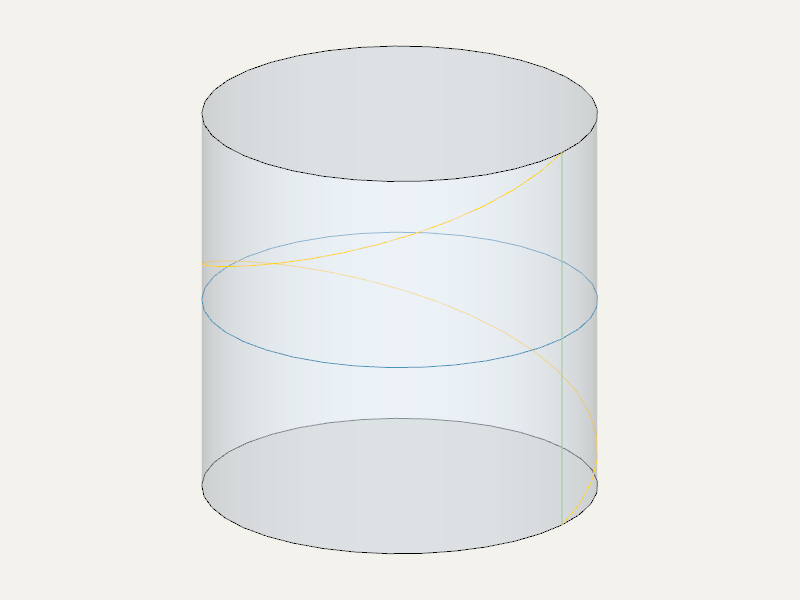
Isocurves are returned as Curve objects. .edge() creates an edge for display; for an infinite curve, specify a range, such as .edge((0, 20)).
A surface can also be built by sweeping a profile along a path.